Recent hikes in airfare prices have made traveling more difficult. Until a few years ago you could find deals to Europe, during the winter time, for under $600 round-trip. However, Europe is not alone when it comes to expensive air fares. My wife was in Montreal for a few days this week on a business trip, and I wanted to join her, but I quickly changed my mind after checking Kayak and looking at the outrageous round-trip fares. The cheapest ticket I could find was a $900 round-trip, non-stop flight from DC to Montreal. The one-stop and two-stop tickets were even more expensive! I couldn't believe my eyes. A round-trip to Montreal from DC used to cost around $200 not that long ago. Is the price of oil making traveling so expensive? Or, should we blame it on the new security measures and airport taxes after 9/11? I don't know what is causing it.
Flying has turned into a somewhat stressful experience, specially if you are like me, always flying couch and looking for the cheapest fare. First you have to deal with huge security lines, which I don't mind because I want to be safe, but it does add some time to your trip. Then, you have to deal with the airlines customer service, which has severely declined in the last 20 years. I remember when I first flew in the late 80s. If your flight was longer than two hours, they would serve you dinner or lunch with metal silverware and free alcohol. And all that happened in the economy class. If you took an overnight flight, they would give you a free toothbrush, free toothpaste, and slippers. Flying used to be a fun thing to do. I can see the time coming when airlines will start charging passengers to use the lavatory.
Thursday, July 26, 2012

Wednesday, July 25, 2012
Week 10: The Olympics
 The 2012 Summer Olympics will start this Friday in London. I have always enjoyed watching the Olympics, particularly the swimming, gymnastics, volleyball, and track and field competitions. The opening ceremony is something that cannot be missed because every four years they come up with a more elaborate version of what was seen four years earlier. It is really interesting to watch the parade of athletes, walking down the stadium, representing their respective countries.
I just wished the TV coverage was more about the sports and less about the personal stories of each athlete, which NBC insists in portraying during their live coverage. It is interesting to know about an athlete's struggle to be in an Olympic team, but I just think they devote too much time to it, and in most cases it becomes way too melodramatic for my taste. That being said, I find the Olympics a fascinating event in the sense that it unites people from different corners of the world, from different cultures, and from different backgrounds.
The vast majority of the athletes competing in the Olympics do not have a shot at winning a medal. They are there to represent their countries, to make the name of their countries heard, and sometimes to make a political statement. I think it is said when politics mixes with sports, though. In 1980, the U.S. and a few other countries boycotted the Moscow Olympics in protest against the Soviet occupation of Afghanistan. Four years later, the Soviet Union along with countries from the communist Eastern Bloc in Europe and Cuba boycotted the 1984 Summer Olympics in Los Angeles. Fortunately, those events have not been repeated since then. The Olympics should be about sports and not about politics.
Thursday, July 19, 2012
Week 9: My ideas for Turning Desktop Apps into Web Apps

As I posted on this week's discussion forum, I would love to see an app for Photoshop, or for some of the other Adobe image editors such as Fireworks. Then, Moses, our classmate, told me about this online app called Photoshop Express, which is a light version of Photoshop, but with all the features needed by even some of the most advanced users. I tried it, and it worked really well! Photoshop and Fireworks are very heavy programs, so I was impressed by how well Photoshop Express handles all those features online, and by how easy it was to edit an image. After you are done editing your images, you can either save it to your computer or share it on Facebook, Picasa, Flickr, or Photobucket. You can also create an account with Photoshop Express and store up to 2GB worth of images. I am yet to find an app for Fireworks though.
The amazing thing about Web apps is that you are not restricted by your hard drive. As long as you have an Internet connection, you can make changes to your documents from any computer. It is really nice to be able to make changes to an image on the fly without having to load up a heavy program from a specific computer. I believe Photoshop Express and Google Docs are making people's lives a lot easier. For one, people will no longer need to carry their laptops around anymore when they are away from their offices and they need to make changes to a graphic or a document.
Wednesday, July 18, 2012
Week 9: My experience this week with JQuery

I think JQuery would be very useful for setting up online calendars and photo galleries. So, JQuery uses Ajax (a combination of CSS, HTML, and Javascript) as one of its features. I have used some free Ajax libraries in the past for creating online photo albums. The CSS Play web site gives you some good examples of that. At work, we use an online database from a third party vendor that has a calendar feature, which looks like something created out of JQuery -- you click on the date field and the calendar pops up. Lightbox was all the hype a few years ago, and it still is the most used script for adding photos to a site. Lightbox enables pictures to overlay on top of the current page.
I followed the instructions on this week's video and played with some of the features on the JQuery website. It does make your site look totally interactive. I can see the draggable feature being used in shopping carts, for example.
Menus are the other cool application for JQuery. The Moo.Fx accordion menu, for example, which uses Ajax, is similar to the accordion menu featured on the JQuery website.
Friday, July 13, 2012
Week 8: My experience with Javascript this week
 This week's exercise on Javascript refreshed my memory on function calling, and writing functions. I took a Javascript last semester, and I have already forgotten some of it. Programming has never been my strong suit, I am really not a big fan of it, but it helps to know the basics when you work on a site as a designer.
Without Javascript sites would be completely static. Things such as image swapping, menus, cookies, and form validation, to name a few, would not be possible without the use of Javascript. I recommend everyone who is into Web design to take a class in Javascript. I would say it is almost mandatory to know a little bit of Javascript if you plan to become a web designer. You need to know where the code is inserted on a page and how to make small changes to it without interfering with the logic of the program.
Online charts and graphs used to be created in Flash. Nowadays, most online charts are created using Javascript. The hicharts website provides users with a great way to create and make changes to an online chart on the fly. It then allows you to copy the Javascript code and paste it into your page. You can manually change the online code, and preview the changes you made to the chart.
The other advantage of Javascript over other dynamic technologies is that it is really light, and it does not require any plugins. Flash, for example, is a dying technology and it will soon no longer be offered by Adobe. There are several issues with Flash. For one, Flash does not play on some smart phones, such as the iPhone, and then you have the issue of plugins. We have pretty much the same issues with Silverlight from Microsoft. Javascript, on the other hand, does not pose any of these problems.

Thursday, July 12, 2012
Week 8: My Idea for a Site Using Javascript
 I've seen quite a few sites that provide you with your expected income after you retire, but none of them take into consideration your life expectancy and/or how you plan to invest your money. If there is, I haven't seen it yet. So, my idea for an interactive web site would be a site that could give you financial advice on how to save and invest your money for retirement based on your current income, expenses, and life expectancy. The page would have three modules.
First, it would ask you for your current income, current age, chances for promotion and future salary increases, inheritance, schooling, degrees intended to be earned, etc. It would also ask you what percentage of your monthly income you currently invest in pension plans, 401ks, saving accounts, etc. Based on the information provided, it would come up with your total projected yearly income for the year you plan to retire based on your age (62.5, 67, 70.5, or an age that you would enter).
Then it would rate you as an investor based on your answers to a questionnaire, and based on your current age (conservative investor, medium investor, aggressive investor). It would then provide you with an expected rate of return on your investment from now until you retire, and the rate of return after you retire, considering you would have less money/no money to invest after you retire.
The third module would calculate your life expectancy based on information provided by you on a questionnaire such as current age, life style (exercise/no exercise, stress level at work and at home, vacation time, etc.), smoking habits, drinking habits, illegal drug use, family history of degenerative diseases (cancer, high blood pressure, diabetes, etc.), and other chronic diseases.
The page would then compute your monthly income after you retire based on information provided in all three modules: total projected income for the year you plan to retire, investor rating, life expectancy.
Friday, July 6, 2012
Week 7: Rio - The Marvelous City
 If you like traveling and experiencing new cultures, Rio is a must see. My last trip to Rio was in 2000 to watch the carnival parade.
The Brazilian capital moved from Rio to Brasilia in 1960. However, Rio remains the main center for culture and entertainment in the country.
Rio is known to Brazilians as the "Marvelous City." Rio's natural setting, its people, and its way of life make this city one of the most fun and exciting places in the world. The inhabitants of Rio, known as "Cariocas," are amongst the most friendly, hospitable, and extroverted people in Brazil.
The land of the biggest show on earth, carnival, Rio is an exhilarating place to be during the summer. Its famous beaches and neighborhoods such as Copacabana, Ipanema, and Leblon gave birth to the Bossa-Nova movement in the late 1950s. Bossa-nova, which means "New Trend" or "New Thing", is a fusion of jazz and samba rhythms. Composers such as Tom Jobim and Joao Gilberto became famous worldwide by writing songs such as Girl from Ipanema, Wave, Desafinado (Out of Tune), Corcovado, and many others.
Rio is undergoing a major transformation right now as the city prepares itself for hosting the two biggest sporting events in the world - the 2014 World Cup (Rio is one of the 12 hosting cities in Brazil) and the 2016 Summer Olympics. I would love be there for either event, but chances are tickets will be very expensive.
Thursday, July 5, 2012
Week 7: Building Online Forms
 For this week's assignment, we built two online forms and added them to our Web sites. We used JotForm for the first form, which is an app for building online forms, and then we built the second one from scratch by entering the HTML code directly into the page.
 My experience with JotForm was really positive. I had never heard of JotForm before, and I was really surprised by how easy it was to create a form and add all the required fields using the app. It seems that they have upgraded the system though since the tutorial video on Blackboard was first published. They now have a source code button, which allows you to easily copy the code and add it to your forms page. On the tutorial, I believe the instructor went to another screen to get the code. I was also looking at the Survey Tools options, and I noticed that you can add fields such as star rating reviews, scale rating, grading review, etc. Under "Power Options" you can add password protected fields and payment options, which I thought it was really amazing.
Building the form from scratch was not that hard for me because I have built online forms before in previous classes. It was a good way to refresh my memory though on all the different input tags.
I received very good feedback on my site. Moses gave me a very good idea on how to improve the form by adding first and last name fields to it in order to identify who provided the feedback.
All in all, it was a fun and educational assignment. It was great to know there is such a great app out there for building online forms.
Thursday, June 28, 2012
Week 6: Andalucia, Southern Spain

Fifteen years ago, my wife and I spent two weeks in Spain. We were in Madrid for two days, visiting some of the sites in the Spanish capital. We also took a day trip to the nearby city of Toledo. A few days later, we took a train and headed south towards Seville. Seville is the biggest city in the region known as Andalucia. The thing I remember the most about this trip is the strong Moorish influence in the architecture of some of the public buildings. That Moorish influence is seen not only in Seville, but also in Cordoba and Granada -- the other two cities in visited on that trip. The main buildings built by the Moors in Seville are the Alcazar and the Giralda Tower. The Alcazar was built by the first Caliph of Andalucia in the 12th century as a fortress, and it then became the Royal Palace after the Spanish regained control of the area. Inside the Alcazar there is a gorgeous palace, and a beautiful garden. The Giralda Tower was built as a minaret next to a mosque. The mosque was latter replaced by the Seville Cathedral, and the minaret is now the bell tower of the cathedral (Sacred Destinations). I also remember watching a live Flamenco show in Seville.
After Seville, we took a bus to Cordoba. Cordoba became famous for advocating religious tolerance. At one point in its history, Jews, Muslims, and Christians coexisted peacefully for many years. The most visited building in Cordoba is the Great Mosque. Inside the mosque (pictured above) there are several rolls of columns and decorated ceilings. The mosque was transformed into a Roman Catholic cathedral after the Spanish regained control of the area. Altars were later placed along the inner walls of the mosque for worshiping catholic saints.
Granada was the most beautiful of the three cities we visited in Andalucia. The Alhambra Alcazar is the biggest and most spectacular Moorish structure in Spain. It is also a fortress featuring a huge garden, large outdoor areas ornamented with fountains, and a very elaborate palace. All areas are open to public visitation. From the Alhambra, there is a beautiful view of the snow peak mountains of the Sierra Nevada.
Sources:
http://www.sacred-destinations.com/spain/seville-giralda
http://www.alhambradegranada.org/en/info/historicalintroduction.asp
http://web.mac.com/jakehartsfield/iWeb/Cordoba/Mosques.html
http://www.seville-traveller.com/alcazar-spain.html
Week 6: OpenOffice - Why Pay for MS Office?
 I have MS Office 2010 installed in my computer at work and also at home. I decided to give OpenOffice a try though, and compare it to MS Office. OpenOffice is an open-source office software distributed by Apache for creating text documents, spreadsheets, presentation, graphics, and databases. It does not come equipped with an e-mail program such as Outlook, though. As an open-source software, it is free to download and use with no restrictions.
The installation itself was pretty easy and it only took a few minutes. One thing I have not figured out yet is how to prevent the database wizard from popping up on my screen every time I open the program. I had to create and name an empty database in my local folder, so I could start the program. So, every time I open the program, and the wizard pops up, I open the empty database, which then allows me to go into the word processing, presentation, and spreadsheet portions of the program.
The great thing about OpenOffice is that it lets you open any document saved in Word, PowerPoint, and Excel. The database program, however, does not let you open a file saved in MS Access with the .mdb file extension. I tried and it didn't work. That being said, the features available in each of these four programs are basically the same ones you find in Word, PowerPoint, Excel, and Access.
I find the word processing software very similar to MS Office and simple to use. The menus are also very user-friendly and self-explanatory with well-defined universal icons for creating links, searching, inserting pictures, paragraphs, font, etc. One cool feature is the button to convert text documents to PDF files. Finding templates to use in my documents was a little challenging, though. Then, I realized I could download templates by going to their page at http://templates.services.openoffice.org/?cid=923508. I was able to open any file format saved in Word (.doc or .docx), but I was not able to save my file as a .docx file, which the new file extension for MS Office 2010. So, I saved it as a .doc file.
The spreadsheet program provides you with all the features most people are used to in Excel - sorting, adding rows, columns, formulas, etc. I was able to open some of my Excel files and save them either as an Excel file , or as ods file (the openoffice extension). As with the text editor, I could not save it in .xlsx format (the 2010 MS office file extension). So, I saved it in the old .xls Excel file format.
Finally, I tested the presentation software. And again, I felt very comfortable using it. The menus are almost identical to PowerPoint. You can edit your slides and add transitions just like you do in PowerPoint. It is also loaded with lots of templates for your slides, and it lets you create a master slide for your presentation. There are five tabs, conveniently located at the top of each slide, offering different slide views (Normal, Outline, Notes, Handout, and Slide Sorter). In PowerPoint, you only get two tabs to the left of the slide (Slides and Outline) and the other ones are detached and located in task bar. As with the text and spreadsheet editors, I could not save it in .pptx format (the 2010 MS office file extension). So, I saved it in the old .ppt PowerPoint file format.
I highly recommend this open-source software to anybody. Regardless of how proficient you are in MS Office, you will be pleasantly surprised by how user-friendly OpenOffice is. There is very little of a learning curve involved.
Wednesday, June 27, 2012
Week 6: Splitwiser - An Online Financial Organizer
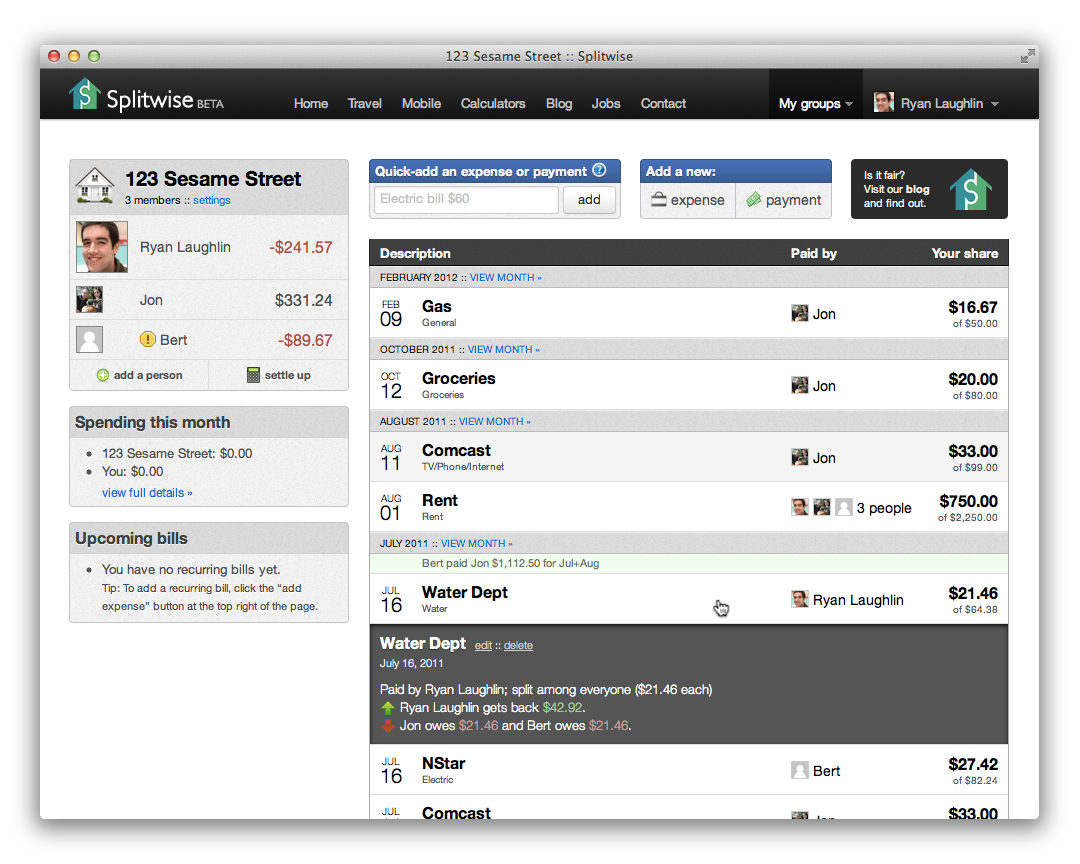 While looking for a free online financial organizer, I came across the beta version of Splitwise. Splitwise is a very simple app that organizes bills by groups of people. That is useful for couples and roommates who split their bills. When you add people to a group, you can name the group (i.e house expenses), and then you have the option of adding e-mail addresses for all the people you add to the group, which is good because they can get notifications of when a recurring bill is due. All the expenses need to be added manually though, but you can check the options for a recurring bill (weekly, monthly, yearly) for each bill individually. They are missing a "quarterly" option, though.
This app is also available for free on iPhone and Android. I tried both the classic and the new version. The new version seems a little cleaner than the classic one. I really like the fact that this app is pretty easy to set up and use. The drawback is that you cannot import transactions from your credit card or bank account. I hope they add that option in the final versions of the program. There is, however, a hidden option in the app to export your expenses in csv format by adding .csv to the end of the URL in any group screen. In addition, Splitwise creates a pie chart of your expenses with a table right below it showing all your expenses, your portion owed for each expense listed, and the total amount you owe. This app also comes loaded with some other cool features such as five different types of calculators -- a rent calculator, a furniture calculator, a guest calculator, a noise calculator (a funny one), and a travel calculator.
Wednesday, June 20, 2012
Week 5: Washington D.C.

I first arrived in D.C. twenty-four years ago on a cold January morning. I landed at National Airport, which has now been renamed to Reagan National Airport, and the ground was covered with ice and snow. I had never seen snow before, so I started kicking the ice on the sidewalks to make sure I was not dreaming. Before the plane landed, I looked out the window and I saw the houses down below covered with snow. A guy whom I became friends with on the plane, and who was also coming to this country for the first time, had a smile on his face as we both marveled at the snow covered houses. He then asked me, "So, what do you think this land will bring us?" To which I replied, "Opportunity, I hope."
Fast-forward twenty-four years, and D.C. is more vibrant than ever before. I still love the variety of food and culture that the city has to offer. A lot of people, however, do not stay in D.C. for a long time. Many people come and stay for two or three years and then go somewhere else. All the foreign embassy diplomats come for a two to four-year tour, and then they are either sent back home or to another country. U.S. government employees also move a lot. Those in the State Department, or those in the Armed Forces tend to move every two years. The same holds true for those working in Congress, depending on the outcome of the congressional and presidential elections.
D.C. is a city that offers a lot of opportunities to young people who are ambitious and bright, and who are ready to conquer the world.
There is also a category of people called the "power hungry" people. Those are the folks who try to impress others by becoming friends with influential people. Name dropping is a common practice amongst them. That's one aspect of this city I'm not crazy about, but as they say, to each its own.
Tuesday, June 19, 2012
Week 5: Siesta Key, My Favorite Spot in Florida
 I go down to Miami once or twice a year to visit my in-laws, and I love the energy of the place, the amazing Cuban food, the electrifying Cuban coffee, the beaches nearby, and of course the weather.
 Prior to 2003, the only other place I had visited in Florida was the Sanibel Islands on the west coast for a long weekend. We loved the peace and quiet of the place, and the warm waters of the Gulf of Mexico. Then, in 2003, we decided to explore the west coast of Florida a little further, and went to Fort Myers and Sarasota.
We liked Fort Myers, but fell in love with Sarasota. Sarasota is a gem. It is located about an hour from Tampa, and an hour and half from Fort Myers on I-75. It is a sophisticated small town that has almost everything you can wish for in a big city: a modern hospital, a renowned University, and great restaurants combined with lots of cultural activities and entertainment. Sarasota is well known for its art galleries, an opera house, the Van Wezel Arts Hall, the Sarasota Orchestra, the John and Mable Ringling Museum of Art, the Sarasota Circus, and many other attractions. My favorite spot is probably the John and Mable Ringling Museum of Art, and the adjacent Ringling Mansion. John was the creator of the famous Ringling Circus in the early 20th century, and the wealth he accumulated throughout the years enabled him to collect works of art by Rubens, van Dyck, Velázquez, Titian, Tintoretto, Veronese, El Greco, Gainsborough and more (John and Marble Ring Museum of Art).
We then visited Siesta Key, which is also part of Sarasota, and it has been named the number one beach in the U.S. It features quartz sand, crystal clear waters, and a variety of birds. It is a perfect spot for sun bathing, swimming, or just walking along the shore. On Sunday nights locals have a drumming session at sunset, which is a lot of fun. People bring their folding chairs and drinks to the beach to watch the amazing sunset every night.
I hope to go back there sometime, and enjoy some peace and quiet for a change.
Week 5: Search Engines and the Wide Availability of Information
 Search engines have made any kind of information available at our fingertips. The Web would be of limited use without search engines. Search engines are our GPS systems for finding information on the Web. In the real world, if you don't have a GPS system and don't know where you are going, you have to either ask somebody or buy a map. On the Web, search engines are our GPS systems, our maps, and the person whom we ask for directions on how to get to the information we need.
Most industries have greatly benefited from the wide availability of online information, which has been made possible through the use of search engines. Education and politics are probably the sectors of society that have benefited the most from it.
Online classes and online libraries made it possible for college students to balance their busy work and family schedules with getting a degree. Issues like copyright infringement and plagiarism related to school work have vastly diminished in the last few years due to the use of software by instructors to detect if plagiarism has been committed. Schools have cracked down on online plagiarism and the penalties are severe, which have prevented students from doing so.
Readily available online information forces politicians to be held accountable for their acts and promises. You can go back and search for a speech a candidate gave before he got elected to office to find out if he has carried out on his promises. Chances are you will be disappointed regardless of your party affiliation. However, during a presidential campaign, having information readily available helps you to make an informed decision about who the best candidate is. You can search for a candidate's record on any particular issue, and then compare his position a few years ago with his position now on that issue.
The news industry has had mixed results with that, however. As mentioned in previous posts, the printed press, if not smart enough to cope and adjust with this new information age, will not be able to compete with the online version of their publications. A lot of newspapers are no longer in circulation. It is up to us, readers, to check and question the validity and credibility of the news being posted online.
Wednesday, June 13, 2012
Week 4: Venice

The train trip from Florence to Venice takes about 3 and 1/2 hours. It cuts through Emiglia Romana, a region that became known for its fine cuisine and places like Bologna, Modena, and Ferrara. As soon as we left the train station in Venice, we started walking towards our Hotel. It was very interesting to be in a place with no cars, only canals, and with streets open to pedestrians. It was liberating in a way. Venice is a unique place, not just because of the canals, but also because of the beautiful architecture you find in every corner of the city. Even more so when you think that the city is slowly sinking, and is flooded almost every year during the winter.
Piazza San Marco, Venice's main square, is the main spot in town and it features the St. Mark's Basilica and the clock tower. The St. Mark's Basilica is considered one of the finest examples of byzantine architecture (Sacred Destinations). I'll never forget the byzantine floor tiles in the church's main hallway. We also went up to the clock tower where we had a 360 degree view of Venice and of all the islands nearby.
We also walked along the famous Bridge of Sighs, made famous in so many Hollywood movies.
I hope I can go back there someday.

Sources:
St. Mark's Basilica, Venice. Sacred Destinations.
Week 4: CSS - separating content from design
CSS is a tool that enables Web designers and developers to separate content from design. Before the advent of CSS, each page had to either be designed individually or you had to create a master template for all your pages. There were a lot of sites using frames back then. If you didn't want to use frames, the only option was to use tables. CSS replaced tables and frames with div tags. You can now create content on a simple HTML page and link to a CSS file to incorporate the design. You do that by saving a CSS file to your root directory, as an individual file with a .css extension, and linking to it from inside the Head tag in your pages. The changes you make to the CSS file are applied to all pages in your site. This is very helpful when you have a site with several pages.
As I mentioned in my previous post, I find the W3 CSS tutorial very helpful. It shows you how to create boxes, div tags, and how to style your headers and links.
There is a wealth of CSS sites out there. I've included below a link to my delicious bookmarks for CSS sites. Some of it is really fun to play with and look at. My favorite page for CSS styles is still the CSS Zen Garden web site. There is a menu on the left hand-side of the CSS Zen Garden site with links to different designs. If you click on one of those links, the design for the page will change but the content will remain the same. Designers and graphic artists post their CSS styles to this site, and allow you to download the code. They do ask you to respect copyright laws.
Nowadays, you can create menus, photo galleries, and even games with CSS.
My CSS bookmarks
CSS Zen Garden
As I mentioned in my previous post, I find the W3 CSS tutorial very helpful. It shows you how to create boxes, div tags, and how to style your headers and links.
There is a wealth of CSS sites out there. I've included below a link to my delicious bookmarks for CSS sites. Some of it is really fun to play with and look at. My favorite page for CSS styles is still the CSS Zen Garden web site. There is a menu on the left hand-side of the CSS Zen Garden site with links to different designs. If you click on one of those links, the design for the page will change but the content will remain the same. Designers and graphic artists post their CSS styles to this site, and allow you to download the code. They do ask you to respect copyright laws.
Nowadays, you can create menus, photo galleries, and even games with CSS.
My CSS bookmarks
CSS Zen Garden
Week 4: Styling my site
I used Notepad to work on my site's pages, and I also used the three sites mentioned on this week's assignment to help me style it. This was a good way to refresh my memory on how to create CSS tags since I haven't had to code pages by hand in a while.
I find the W3 CSS tutorial very helpful. It shows you how to create boxes, like the one I added to the middle of my page, div tags, and how to style your headers and links. I also used the somacom.com web site for getting the hexadecimal code for the colors I used for the page background, headers, and links.
Designing a simple page like this one does not require a lot of planning, but it is always advisable to create a sketch of what you envision your site or pages to look like before you actually start typing the code. You can use a blank sheet of paper and start drawing a organizational chart, something like this:
Home page (index.html)
|
|
Videos <--> Images <--> etc. (videos.html, images.html, etc.)
For this exercise, I just followed the assignment instructions for some of the CSS styles, and I enclosed a free image of a world map inside a div tag, which I also used as a navigation tab to toggle back and forth between the site pages.
One technique that is used a lot in most sites today is the styling of links. I added css styles for visited links, active links, mouse over links, and selected links. You can view the code for the homepage by right-clicking anywhere on the page and selecting "View Page Source" or "View Source".
You can also save a CSS file to your root directory, as an individual file with a .css extension, and link to it from inside the Head tag in your pages. That way, you don't have to type the CSS code on each and every page, and the changes you make to the CSS file are applied to all pages. This is very helpful when you have a site with several pages.
My site
I find the W3 CSS tutorial very helpful. It shows you how to create boxes, like the one I added to the middle of my page, div tags, and how to style your headers and links. I also used the somacom.com web site for getting the hexadecimal code for the colors I used for the page background, headers, and links.
Designing a simple page like this one does not require a lot of planning, but it is always advisable to create a sketch of what you envision your site or pages to look like before you actually start typing the code. You can use a blank sheet of paper and start drawing a organizational chart, something like this:
Home page (index.html)
|
|
Videos <--> Images <--> etc. (videos.html, images.html, etc.)
For this exercise, I just followed the assignment instructions for some of the CSS styles, and I enclosed a free image of a world map inside a div tag, which I also used as a navigation tab to toggle back and forth between the site pages.
One technique that is used a lot in most sites today is the styling of links. I added css styles for visited links, active links, mouse over links, and selected links. You can view the code for the homepage by right-clicking anywhere on the page and selecting "View Page Source" or "View Source".
You can also save a CSS file to your root directory, as an individual file with a .css extension, and link to it from inside the Head tag in your pages. That way, you don't have to type the CSS code on each and every page, and the changes you make to the CSS file are applied to all pages. This is very helpful when you have a site with several pages.
My site
Tuesday, June 12, 2012
Week 4: My Trip to Rome
Rome can be both fascinating and somewhat stressful for a tourist. That being said, I was there for just 3 days, so my experience was very limited.
I arrived in Rome by train from Florence on a cold morning in March eight years ago. After I left the train station, I went to the travel agency nearby, which I had contacted a few days earlier and made arrangements for a guided walking tour of the old city.
From there, I hopped in a cab and went to my hotel, which was located in a hilly residential neighborhood west of the Vatican. On my way to the hotel, we hit some traffic jam, which is very common throughout Rome, and then snow started to fall. The cab driver told me it rarely snows in Rome. It was just flurries but enough to make the traffic worse and the Italian drivers more animated. During my cab ride I kept wondering how many cups of coffee Italians drink on a normal weekday. I'm a coffee lover myself, but I can't have more than two cups a day, specially if I have a real Italian espresso.
After I checked into my hotel, I walked around the neighborhood, which reminded me a lot of a neighborhood in my hometown. Later that day, I jumped on the subway towards the Coliseum where I met my tour guide and the group of tourists that had signed up for the walking tour. On the crowded subway ride, though, I witnessed a fight between two women. At first, they were just yelling at each other, but after a while they started hitting each other. Fortunately, a man standing right next to them stopped the fight. Too much caffeine is my theory, along with a hot Latin temper. Somehow, it was all very familiar to me. I felt right at home.
The walking tour took us to the Coliseum, the Pantheon, and the Old City of Rome where the Forum is located. We also walked to the Spanish steps where I had dinner later that day. The ruins of the Old City and the Forum are just spectacular.
The next day, I went to the Vatican on my own. I think the Sistine Chapel is probably one the most spectacular sights I have ever visited.
On my final day, I walked around the fancy shops on Via Venetto, took some pictures of the latest Lamborghini model at the Lamborghini store, and headed back to the train station. I didn't have time to check the catacombs, which are the underground burial places going back to the Roman times.
One thing to remember in Rome is to be careful when you cross the streets, drivers do not yield to pedestrians, and if you have to drive, practice defensive driving. Other than that, I highly recommend it. It's one of those cities you have to see, if you love traveling.

I arrived in Rome by train from Florence on a cold morning in March eight years ago. After I left the train station, I went to the travel agency nearby, which I had contacted a few days earlier and made arrangements for a guided walking tour of the old city.
From there, I hopped in a cab and went to my hotel, which was located in a hilly residential neighborhood west of the Vatican. On my way to the hotel, we hit some traffic jam, which is very common throughout Rome, and then snow started to fall. The cab driver told me it rarely snows in Rome. It was just flurries but enough to make the traffic worse and the Italian drivers more animated. During my cab ride I kept wondering how many cups of coffee Italians drink on a normal weekday. I'm a coffee lover myself, but I can't have more than two cups a day, specially if I have a real Italian espresso.
After I checked into my hotel, I walked around the neighborhood, which reminded me a lot of a neighborhood in my hometown. Later that day, I jumped on the subway towards the Coliseum where I met my tour guide and the group of tourists that had signed up for the walking tour. On the crowded subway ride, though, I witnessed a fight between two women. At first, they were just yelling at each other, but after a while they started hitting each other. Fortunately, a man standing right next to them stopped the fight. Too much caffeine is my theory, along with a hot Latin temper. Somehow, it was all very familiar to me. I felt right at home.
The walking tour took us to the Coliseum, the Pantheon, and the Old City of Rome where the Forum is located. We also walked to the Spanish steps where I had dinner later that day. The ruins of the Old City and the Forum are just spectacular.
The next day, I went to the Vatican on my own. I think the Sistine Chapel is probably one the most spectacular sights I have ever visited.
On my final day, I walked around the fancy shops on Via Venetto, took some pictures of the latest Lamborghini model at the Lamborghini store, and headed back to the train station. I didn't have time to check the catacombs, which are the underground burial places going back to the Roman times.
One thing to remember in Rome is to be careful when you cross the streets, drivers do not yield to pedestrians, and if you have to drive, practice defensive driving. Other than that, I highly recommend it. It's one of those cities you have to see, if you love traveling.
Wednesday, June 6, 2012
Week 3: Florence - A Place Like No Other
We are planning our next summer trip to Europe. This will be our first trip back to Europe in almost seven years. We have been saving some money for this trip for a while, so we are finally able to do it now. I had to twist my wife's arm this time around though. She wanted to go back to Italy, and I kept telling her that we needed to go to a different region. And I think I won because we will be going to Central Europe to visit the cities of Prague, Vienna, and Budapest.
Ah... La bella Italia... a place like no other. My wife was in Florence, Naples, and Milan for work for several months between 2004 and 2005, which was an ideal time for me to visit. I was able to visit Florence, Venice and Rome, but I never made it to Naples or Milan. It was great though to finally see a country I had heard so much about.
So, I joined her in Florence, a city that is the birth place of the Renaissance. Florence is the place where artists like Michelangelo, Leonardo Da Vinci, Donnatelo, Botticelli and many others produced some of the most well known works of art in history. It is quite amazing when you stop and think about it.
Florence is a magical place, even for someone who is not into arts or history. The architecture of the Il Duomo, which is the third largest cathedral in Europe, is breathtaking. It was built by Brunelleschi, a Florence architect who was the first one to build a dome structure with bricks. But there are many other churches in Florence, which are not only beautiful, but also have a deep historical relevance. The Basilica di Santa Croce, for example, not far from Il Duomo, is the burial place for Michelangelo, Galileo, Machiavelli, and many others.
Amongst the many museums in Florence, a must see is the Uffizi Museum, which features several paintings and sculptures from Renaissance painters. The word Uffizi means Office in Italian, and it was home to the offices of the Medici family, the ruling Florentine family at the time. The Medici family owned the banking business in Florence, and they commissioned several works of art.
We also visited a few other towns in Tuscany, and then made it to Rome and Venice. But I'll save that for another post. If you haven't been to Florence yet, please plan do it sometime in your lifetime. It is well worth a visit!
Ah... La bella Italia... a place like no other. My wife was in Florence, Naples, and Milan for work for several months between 2004 and 2005, which was an ideal time for me to visit. I was able to visit Florence, Venice and Rome, but I never made it to Naples or Milan. It was great though to finally see a country I had heard so much about.
So, I joined her in Florence, a city that is the birth place of the Renaissance. Florence is the place where artists like Michelangelo, Leonardo Da Vinci, Donnatelo, Botticelli and many others produced some of the most well known works of art in history. It is quite amazing when you stop and think about it.
Florence is a magical place, even for someone who is not into arts or history. The architecture of the Il Duomo, which is the third largest cathedral in Europe, is breathtaking. It was built by Brunelleschi, a Florence architect who was the first one to build a dome structure with bricks. But there are many other churches in Florence, which are not only beautiful, but also have a deep historical relevance. The Basilica di Santa Croce, for example, not far from Il Duomo, is the burial place for Michelangelo, Galileo, Machiavelli, and many others.
Amongst the many museums in Florence, a must see is the Uffizi Museum, which features several paintings and sculptures from Renaissance painters. The word Uffizi means Office in Italian, and it was home to the offices of the Medici family, the ruling Florentine family at the time. The Medici family owned the banking business in Florence, and they commissioned several works of art.
We also visited a few other towns in Tuscany, and then made it to Rome and Venice. But I'll save that for another post. If you haven't been to Florence yet, please plan do it sometime in your lifetime. It is well worth a visit!
Week 3: My Two Cents on Traveling

We all have our passions and hobbies in life. For some, gardening is what gives them the relaxation they need to cope with a stressful life. For others, watching their favorite sports team gives them something to do on the weekends and something to talk about with friends and co-workers. I love sports and I hate gardening. If I had to name one of the many things I enjoy doing in life, aside from watching my favorite sports team, traveling would be at the top of my list.
Throughout the years I have done some traveling, not as much as I would like to have, and not nearly as much as some of my relatives have, but every new place I went to provided me with a new and rewarding experience.
In order to get the most out of my trips, I try to keep an open mind and I try to be prepared for any unexpected delays or cancellations. When things do not work the way I planned, I do get a little frustrated for a while, but then I just go with the flow and I try to come up with alternative solutions. It sure beats being at the office, even if some of your planned sightings or events fall through.
Aside from planes or train schedules, I do not believe in schedules when I am on vacation. While it is somewhat important to cover the main attractions, schedules kill spontaneity. I live on a schedule 24/7 for most of the year, and there is a lot planning already going into planning a trip. So, when I go to a new place, I know beforehand some of the sites I would like to see, but if something more interesting pops up, I have no problem in revising my plans. I know some folks who travel a lot, and they plan every step of the way, from the moment they step out of the house to when they fly back home. To each its own, as I always say, but that kind of trip leaves very little to the imagination. That sounds to me like a task that needs to be accomplished, rather than a trip that should be enjoyed. I also do not go to a new place just to add it to a list of places I have visited; I go to a new place to experience something new -- a new culture, a new cuisine, a new city, and a new country.
Tuesday, June 5, 2012
Week 3: The Effects of the Internet on Various Media Outlets

The internet has had a tremendous effect on every type of media outlet, including newspapers, magazines, TV, film and music industries, and radio broadcast.
On the positive side, the interactive nature of the Internet has provided consumers with easy and fast access to the news, and it has also enabled anyone to voice his/her own opinion on a particular issue through blogs and comment fields. We no longer need to rely on buying the daily paper or the weekly magazine to get the latest news, or wait for the latest CD to come out. Most people now turn the computer on in the morning and go to their favorite news web site for the latest news, instead of getting the paper from their door step or from a newsstand. We can now purchase individual songs and download them to our smart phones and mp3 players and carry our entire music library with us. We no longer need to go to a video store (remember those?) to rent our movies. Movies can now be streamed directly to our computer, smartphone, or TV through an Internet vendor. We can even get live television in our computers through IPTV, which is a system that provides television services through Internet protocol. In addition, anyone with a video camera can now broadcast daily on the Internet through web sites such as ustream.tv. We are no longer restricted by short wave signals, as radio stations from around the world now stream their live broadcast over the Internet. Those of us old enough to have lived through the early days of MTV remember how much fun it was to watch their latest music videos, which are now available on YouTube. And that brings me to the issue of copyright infringement. The unscrupulous copying of videos and music files has had a negative effect on both the film and the music industries. In the end, we all pay the price of copyright infringement. We see the rise in the prices of DVDs, CDs, and concert tickets to make up for the loss in revenue resulting from illegal copying and downloading of music and video files.
Monday, June 4, 2012
Week 3: Embedding Videos in Blog Articles
Continuing with one of my favorite topics, here's a video I found on YouTube about Southern Spain, the region called Andalusia.
Thursday, May 31, 2012
Week 2: How the Internet Has Changed the Way We Communicate
Before the Internet we had two main ways of communicating with people - phone and written letters. I still remember writing letters to my parents when making an international call was prohibitively expensive for a college kid. International calls were reserved for special occasions such as birthdays, Christmas, and New Year's eve. The internet has changed all that, and it has shortened the distances. It has also changed our relationships with friends, family, and co-workers.
Nowadays, I can call my relatives overseas using the Skype app in my i-Phone, which is something I did this past weekend during my trip to Boston.
Email is the other tool we often use, and which has replaced letters and most phone calls. The vast majority of my daily tasks at work are assigned to me via email. Before email entered the work place, those same tasks were assigned to me by phone or by memo. Email, however, has its own sets of rules that we should abide by. Email etiquette at work, for example, is something that we should always practice. We need to remind ourselves that an email is a written record, which can be easily forwarded to anybody.
Smart phones have made texting one of the most popular ways of communication amongst teenagers and adults alike. Texting, though, as well as most of the Internet tools discussed here, can lead to decreased social skills, as face-to-face contact is no longer a requirement.
Social networking sites such as Facebook, TwItter, Linkedin, Google Circles, and others before them such as Orkut and Myspace have changed the way people interact with one another. Social networking provided a way for people to communicate and share their lives and daily activities with hundreds and sometimes thousands of people.
There are pros and cons related to the use of social networking. On the plus side, social networks can have a positive impact on getting people's attention to a common cause. A good example of that were the events leading up to the Arab spring in 2011. In places like Tunisia and Egypt the people's uprising against the government was coordinated through Tweeter and Facebook. TwItter was also used in 2010 during a protest against the government by civilians in Teheran, in which a video of a woman being killed during the protest became viral and hit the headlines across the world.
One of the downsides related to the use of social networks is obviously the invasion of one's privacy as everything that one posts about his/her personal life becomes public. The other downside associated with social networks is the spam resulting from an excessive number of messages posted several times a day by some users about every minor aspect of their lives. The other form of spam is the constant posting of chain messages with a religious connotation, or of any type of chain message.
Week 2: My Weekend in the Boston Area - The Commencement Ceremony

This past weekend, my wife and I went up to the Boston area to attend the commencement ceremony in Lowell. The commencement ceremony itself was really memorable, extremely well organized, and it featured great speakers. The U.S. Secretary of the Interior, Ken Salazar, gave an inspirational speech about his humble beginnings in Colorado, and how he became the first generation in his family to obtain a college degree. His speech made us all proud, and brought back memories of when I first came to this country. My uncle, who is no longer with us, brought me here on a student visa many years before I started taking classes at UMass. I was fresh off the boat when I went to American University to attend their ESOL classes. Later on, I got my associates degree from a community college, went back overseas for work, and came back to the U.S. years later. And that was when I decided to get my bachelor's degree at UMass. It has been a very rewarding experience since then.
Getting a degree reinforces the idea that everything is possible if you work hard toward your goals. I also believe that getting a degree in my forties makes me appreciate it more than if I had gotten it when I was in my twenties. All those nights and weekends working on my assignments have paid off.
Never give up on your dreams, keep fighting for them, and sooner or later they will come true.
Subscribe to:
Posts (Atom)